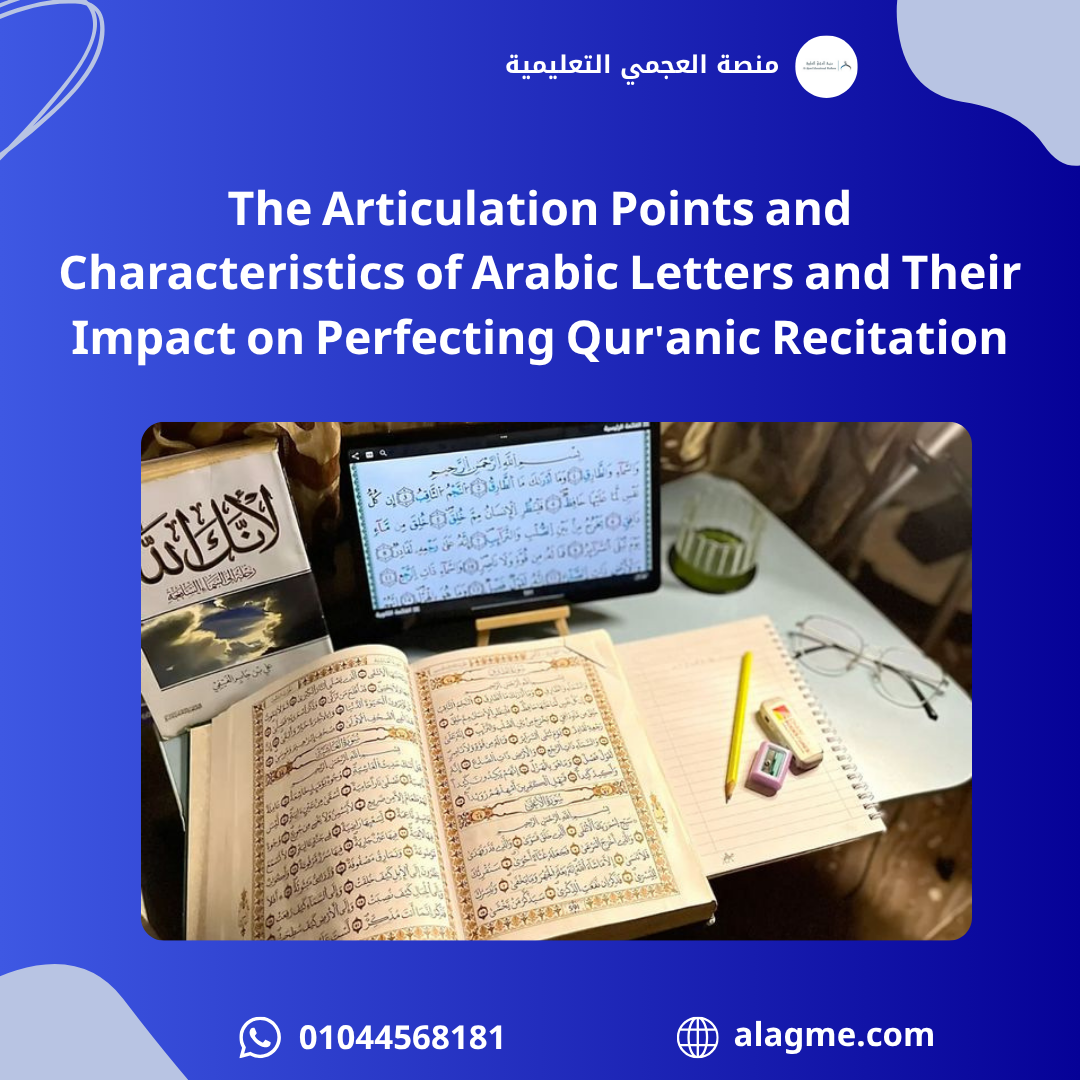
The science of Tajwīd is among the noblest sciences associated with the Book of Allah. Its primary purpose is to ensure that the Qur'an is recited exactly as it was revealed to the Prophet Muhammad ﷺ by giving every letter its due rights and characteristics. Among the most significant branches of Tajwīd—and one that has the greatest influence on improving and perfecting recitation—is the study of the articulation points (Makhārij al-Ḥurūf) and the characteristics (Ṣifāt al-Ḥurūf) of the Arabic letters. A letter cannot be pronounced correctly unless both its point of articulation and its inherent characteristics are properly understood. For this reason, scholars of Tajwīd devoted great attention to this subject, considering it the very foundation upon which accurate Qur'anic recitation is built.
Allah the Almighty commands:
"And recite the Qur'an with measured recitation." (Qur'an 73:4)
True Tartīl (measured and deliberate recitation) can only be achieved by articulating every letter from its correct point of origin while observing all of its phonetic characteristics and rules. The Prophet Muhammad ﷺ recited the Qur'an with exceptional clarity and precision. His Companions meticulously transmitted the exact manner of his pronunciation, and the following generations inherited this knowledge through direct oral transmission until it reached us as one of the most carefully preserved sciences in Islamic tradition.
The articulation point (Makhraj) of a letter refers to the exact location within the speech organs from which the letter originates, allowing it to be distinguished from every other sound. Whenever a reciter pronounces a letter while relying upon a specific place within the vocal tract, that location is considered its articulation point.
The characteristic (Ṣifah) of a letter, on the other hand, describes the manner in which the letter is produced as it emerges from its articulation point. These characteristics include qualities such as voicing and whispering (Jahr and Hams), strength and softness (Shiddah and Rikhāwah), elevation and lowering of the tongue (Isti'lā' and Istifāl), among many others. Together, these characteristics give every Arabic letter its unique phonetic identity.
Although scholars have differed regarding the detailed number of articulation points, the opinion adopted by the majority of Tajwīd scholars is that there are seventeen specific articulation points, grouped under five major regions:
The Oral and Throat Cavity (Al-Jawf)
The Throat (Al-Ḥalq)
The Tongue (Al-Lisān)
The Lips (Ash-Shafatān)
The Nasal Passage (Al-Khayshūm)
The first major articulation area is Al-Jawf (the oral and throat cavity), the open space extending through the mouth and throat. From this cavity emerge the three long vowels (letters of prolongation):
The Alif preceded by a fatḥah,
The Wāw preceded by a ḍammah,
The Yā' preceded by a kasrah.
Unlike other letters, these sounds do not rely upon a particular organ of speech. Instead, their sound flows freely through the cavity of the mouth and throat. For this reason, they are known as the cavity letters (Al-Ḥurūf al-Jawfiyyah) or air letters.
The second major articulation region is the throat (Al-Ḥalq), which contains three distinct articulation points.
The deepest part of the throat, nearest to the chest, produces the letters Hamzah (ء) and Hā' (هـ).
The middle part of the throat produces 'Ayn (ع) and Ḥā' (ح).
The upper part of the throat, closest to the mouth, produces Ghayn (غ) and Khā' (خ).
These six letters are collectively known as the throat letters (Al-Ḥurūf al-Ḥalqiyyah) because their pronunciation depends primarily upon the throat.
The tongue is by far the most active speech organ in the Arabic language. Consequently, the majority of Arabic letters originate from different parts of the tongue.
The deepest part of the tongue, together with the area directly opposite it on the soft palate, produces the letter Qāf (ق). Immediately in front of this articulation point is the point from which Kāf (ك) is pronounced.
The middle of the tongue, meeting the hard palate, produces Jīm (ج), Shīn (ش), and the non-lengthened Yā' (ي).
The side—or one or both sides—of the tongue pressed against the upper molars produces the letter Ḍād (ض), the unique letter for which Arabic has long been known as "the language of Ḍād."
From the lower side of the tongue extending toward its tip and touching the gums of the upper teeth comes Lām (ل).
The tip of the tongue touching the gums behind the upper central incisors produces Nūn (ن), while a nearby point produces Rā' (ر).
The tip of the tongue touching the roots of the upper front teeth articulates Ṭā' (ط), Dāl (د), and Tā' (ت).
The tip of the tongue positioned between the upper and lower teeth produces Ṣād (ص), Zāy (ز), and Sīn (س).
Finally, the tip of the tongue lightly touching the edges of the upper incisors produces Ẓā' (ظ), Dhāl (ذ), and Thā' (ث).
The fourth major articulation region consists of the lips (Ash-Shafatān). By fully closing both lips, the letters Bā' (ب) and Mīm (م) are pronounced. The non-lengthened Wāw (و) is articulated by rounding the lips without completely closing them. The letter Fā' (ف) is produced by placing the inner edge of the lower lip against the tips of the upper front teeth.
The fifth articulation region is the nasal passage (Al-Khayshūm). It is from this cavity that Ghunnah (nasal resonance) is produced. Ghunnah accompanies the letters Nūn and Mīm, especially when they are doubled (Mushaddad) or when they occur in Tajwīd rules such as Ikhfā' (concealment) and Idghām (assimilation).
Understanding the articulation points of the Arabic letters is not merely a theoretical exercise; rather, it has immense practical value in ensuring the correctness of Qur'anic recitation. Many pronunciation mistakes made by reciters stem from an inaccurate understanding of a letter's proper articulation point. For example, some people confuse the letters Ḍād (ض) and Ẓā' (ظ) because of the similarity in their sounds, while others may mistake Sīn (س) for Ṣād (ص), Tā' (ت) for Ṭā' (ط), or Dhāl (ذ) for Zāy (ز). Such errors may sometimes alter the intended meaning of the Qur'anic text or compromise the eloquence and precision of its recitation.
While the articulation points determine where a letter originates, the characteristics (Ṣifāt al-Ḥurūf) determine how it is pronounced. For this reason, scholars of Tajwīd emphasize that every Arabic letter is distinguished not only by its articulation point but also by its inherent characteristics. In some cases, two letters may share the same or a very similar articulation point, yet they remain distinct because each possesses unique phonetic qualities.
The characteristics of the letters are generally classified into two categories:
Characteristics that have opposites (Ṣifāt Lāhā Aḍdād).
Characteristics that have no opposites (Ṣifāt Lā Aḍdād Lahā).
Among the most important paired characteristics are Jahr (voicing) and Hams (whispering).
A voiced letter (Majhūr) is one in which the flow of breath is restrained during pronunciation, whereas a whispered letter (Mahmūs) allows the breath to flow freely. The whispered letters are traditionally gathered in the mnemonic phrase:
"Faḥaththahu Shakhṣun Sakat"
representing the following ten letters:
Fā' (ف), Ḥā' (ح), Thā' (ث), Hā' (هـ), Shīn (ش), Khā' (خ), Ṣād (ص), Sīn (س), Kāf (ك), and Tā' (ت).
Another important group of characteristics consists of Shiddah (strength), Rikhāwah (softness), and Tawassuṭ (moderation).
Letters possessing Shiddah completely stop the flow of sound during pronunciation. These include:
Hamzah (ء), Jīm (ج), Dāl (د), Qāf (ق), Ṭā' (ط), Bā' (ب), Kāf (ك), and Tā' (ت).
In contrast, Rikhāwah allows the sound to continue flowing freely as the letter is pronounced. Between these two extremes lies Tawassuṭ, where the sound is neither completely stopped nor entirely unrestricted, but flows moderately.
Among the most significant characteristics are Isti'lā' (elevation of the tongue) and Istifāl (lowering of the tongue).
The letters of Isti'lā' are those in which the back of the tongue rises toward the roof of the mouth during pronunciation. They are traditionally memorized by the phrase:
"Khuṣṣa Ḍaghṭin Qiẓ"
representing the seven letters:
Khā' (خ), Ṣād (ص), Ḍād (ض), Ghayn (غ), Ṭā' (ط), Qāf (ق), and Ẓā' (ظ).
These letters are generally pronounced with Tafkhīm (heaviness or emphasis).
All remaining Arabic letters belong to Istifāl, meaning that the tongue remains lowered, resulting in a lighter pronunciation known as Tarqīq (lightness).
Another important characteristic is Iṭbāq (complete tongue contact), which is exclusive to four letters:
Ṣād (ص), Ḍād (ض), Ṭā' (ط), and Ẓā' (ظ).
During their pronunciation, a substantial portion of the tongue presses against the roof of the mouth, giving these letters additional strength and resonance.
In contrast, the remaining Arabic letters possess the opposite quality known as Infitāḥ (opening), where the tongue does not create this complete contact with the palate.
Some characteristics do not have opposites.
Among the most well-known is Qalqalah, a slight bouncing or echoing sound heard when one of the five letters:
Qāf (ق), Ṭā' (ط), Bā' (ب), Jīm (ج), and Dāl (د)
is pronounced in a state of sukūn (absence of a vowel). This effect results from a brief vibration at the articulation point, producing a distinct audible resonance.
Another unique characteristic is Ṣafīr (whistling), found in the letters:
Ṣād (ص), Sīn (س), and Zāy (ز).
Likewise, Inḥirāf (deviation) is a characteristic associated with Lām (ل) and Rā' (ر), while Takrīr (slight vibration) belongs specifically to Rā' (ر). It is important to note that although Takrīr is an inherent characteristic of the letter Rā', the reciter should avoid excessive rolling of the tongue during its pronunciation.
The letter Ḍād (ض) possesses the unique characteristic of Istiṭālah (elongation), in which the sound extends along the side of the tongue.
The letter Shīn (ش) is distinguished by Tafashshī (spreading), whereby the sound disperses broadly throughout the mouth.
Finally, Ghunnah (nasal resonance) is a defining characteristic of both Nūn (ن) and Mīm (م), produced through the nasal cavity (Al-Khayshūm).
The significance of these characteristics becomes especially evident when comparing letters that originate from similar articulation points.
For example, Tā' (ت) and Ṭā' (ط) emerge from nearly the same area of the tongue. However, Ṭā' is characterized by Isti'lā', Iṭbāq, and Tafkhīm, giving it a heavy and emphatic sound, whereas Tā' is a light letter possessing Istifāl and Infitāḥ.
Likewise, Ṣād (ص) and Sīn (س) are articulated from neighboring positions. Nevertheless, Ṣād is elevated and emphatic, while Sīn remains light and delicate. Ignoring these distinguishing characteristics results in distorted pronunciation and deprives each letter of its authentic phonetic identity.
One of the greatest benefits of mastering the articulation points and characteristics of the Arabic letters is that it enables the reciter to avoid Laḥn (errors in Qur'anic recitation). Laḥn refers to any mistake made while reciting the Qur'an. It is generally classified into two types: manifest error (Laḥn Jaliyy), which may alter the meaning of the Qur'anic text or violate an established rule of pronunciation, and subtle error (Laḥn Khafiyy), which relates to deficiencies in the proper application of the rules of Tajwīd without necessarily changing the meaning.
A reciter who understands the precise articulation points and phonetic characteristics of the Arabic letters is able to pronounce every letter correctly, avoiding distortion, substitution, or omission. Such mastery preserves the integrity of the Qur'anic text and fulfills the objective of reciting the words of Allah as they were revealed.
Studying the articulation points and characteristics also contributes significantly to beautifying one's recitation. The beauty of Qur'anic recitation is not based solely upon possessing a pleasant voice. Rather, true excellence is achieved through the combination of a beautiful voice and accurate pronunciation. Many individuals are naturally gifted with melodious voices, yet they cannot attain a high level of proficiency in Qur'anic recitation unless they also master the principles of Tajwīd and apply them consistently.
Another major benefit of this science is that it facilitates the learning of Qur'anic recitation for non-Arabic speakers. Numerous Arabic sounds have no equivalent in many other languages, making them particularly difficult for non-native speakers to pronounce. Examples include the letters Ḍād (ض), 'Ayn (ع), Ḥā' (ح), Ghayn (غ), and Qāf (ق). By learning the exact articulation point and characteristic of each letter, students are better equipped to pronounce these sounds accurately and confidently.
For this reason, scholars of the Qur'an have consistently emphasized that Tajwīd cannot be mastered through books alone. While written texts explain the articulation points, characteristics, and rules of pronunciation, true proficiency is attained only through direct oral instruction (Talaqqī) under the supervision of qualified teachers. Listening to a skilled reciter, imitating the correct pronunciation, and receiving immediate correction remain the most effective methods of learning Tajwīd.
This principle explains why the transmission of the Qur'an has always relied upon an unbroken chain of oral instruction stretching back to the Prophet Muhammad ﷺ. Every generation of qualified reciters learned directly from the preceding generation through careful listening, recitation, and correction, thereby preserving not only the words of the Qur'an but also the precise manner of their pronunciation.
The articulation points and characteristics of the Arabic letters are therefore not merely theoretical topics studied in books. Rather, they constitute the very foundation of correct Qur'anic recitation and the essence of accurate pronunciation. The more a reciter studies these principles and practices them under proper guidance, the clearer, more eloquent, and more spiritually moving his or her recitation becomes.
Anyone who carefully listens to the world's most accomplished Qur'an reciters quickly realizes that the excellence of their recitation is not attributed solely to the beauty of their voices. Their distinction lies primarily in their ability to articulate every letter from its precise point of origin while observing all of its inherent characteristics without exaggeration or negligence. This meticulous attention to detail gives their recitation its remarkable clarity, balance, and reverence.
In conclusion, mastering the articulation points and characteristics of the Arabic letters is among the greatest means by which a Muslim preserves the authenticity of the Qur'anic recitation. It safeguards the tongue from error, protects the words of Allah from distortion, and enables the reciter to fulfill the divine command:
"And recite the Qur'an with measured recitation." (Qur'an 73:4)
Anyone who aspires to excellence in the recitation of the Noble Qur'an should make the study of Makhārij al-Ḥurūf and Ṣifāt al-Ḥurūf an essential part of their journey with the Book of Allah. These sciences are the true key to accurate recitation and the bridge that leads the reciter toward mastery (Itqān) and spiritual excellence (Iḥsān) in the recitation of the Holy Qur'an.
Ultimately, the proper articulation and characterization of every letter are not simply technical skills; they are acts of devotion through which Muslims honor the words of their Lord. By combining sound knowledge, consistent practice, and direct learning from qualified teachers, reciters preserve a sacred tradition that has been transmitted faithfully from the Prophet Muhammad ﷺ through successive generations. In doing so, they fulfill both the outward precision and the inward reverence that define the true spirit of Tajwīd.

💬 اترك تعليقك