
In the course of Islamic legislation, certain temporal seasons are uniquely honored and venerated by Allah Almighty. These periods serve as spiritual stations for renewing the covenant with the Creator and purifying souls from the rust of materialism. Among these luminous times, the first ten days of Dhu al-Hijjah stand out as the pinnacle of seasons for acts of worship. Within these blessed days, the Day of Arafah—the ninth day of this month—emerges as the crown jewel and the beating heart. The Day of Arafah is not merely a passing day in the Muslim calendar; rather, it is a major spiritual phenomenon and a global devotional conference where the hearts of the Ummah converge upon a single plain. During this day, divine mercies descend to encompass the inhabitants of the earth with forgiveness and emancipation from the Fire. This article aims to shed light on the virtue of this great day from an academic perspective that combines forensic authentication with behavioral awareness, reviewing its deep significance and its impact on shaping the Muslim personality.
The Legislative Status and Quranic Context of the Day of Arafah
Days derive their significance in Islam from the legislative events and devotional manifestations that occur within them, and the Day of Arafah has acquired virtues unmatched by any other day. Islamic legislative sources from the Quran and Sunnah indicate that this is the day on which Allah perfected the religion and completed His favor upon the Muhammadan Ummah. In the two Sahihs, it is narrated that a man from among the Jews came to Umar ibn al-Khattab, may Allah be pleased with him, and said: "O Commander of the Faithful, there is a verse in your Book which you recite; if it had been revealed to us, the Jewish people, we would have taken that day as a festival." When Umar asked him about it, he recited the words of Allah Almighty in Surah Al-Ma'idah: "This day I have perfected for you your religion and completed My favor upon you and have approved for you Islam as religion." Umar replied that it was revealed on the Day of Arafah, which was a Friday. This correlation between the perfection of the religion and the Day of Arafah carries a profound academic implication, demonstrating that this day represents the final declaration of the comprehensive Islamic methodology. It stands as the definitive covenant that Allah approved for humanity, which necessitates that Muslims recognize this blessing and be aware of its legislative value.
Furthermore, Allah Almighty swore by this day in His Noble Book in multiple places to magnify its status. A divine oath by an object in the Holy Quran is considered definitive proof of the nobility and gravity of that object. A multitude of commentators, relying on prophetic traditions, have argued that the Day of Arafah is the "Witnessed" day by which Allah swore in Surah Al-Buruj, where He said: "And [by] the witness and what is witnessed." It is narrated in the Sunan collections that the witness is Friday and the witnessed is the Day of Arafah. It is also the "Odd" number by which Allah swore in Surah Al-Fajr in His saying: "And [by] the even and the odd," as Ibn Abbas, may Allah be pleased with them both, interpreted the even as the Day of Sacrifice and the odd as the Day of Arafah. This Quranic celebration places us before a cognitive and educational responsibility to realize the value of this time and to handle its minutes with extreme spiritual caution lest they be wasted in anything other than obedience.
Devotional Dimensions and the Virtue of Fasting for Non-Pilgrims
Acts of worship on the Day of Arafah vary to accommodate the circumstances of all Muslims, whether those decreed to witness the great gathering on the plain of Arafat, or those who remain in their homelands, looking forward to the breezes of divine descent. For the general body of non-pilgrim Muslims, Islam legislated the act of fasting on this day as one of the most important means to draw closer to Allah and to compensate for any deficiencies in deeds. Regarding the virtue of fasting on this day, the Prophet, peace and blessings be upon him, said when asked about fasting on the Day of Arafah: "It expiates the sins of the past year and the coming year."
This prophetic tradition represents a great educational and awareness-raising approach. How can a righteous deed lasting only a single day erase the sins of two entire years? Scholars explain this expiation as a favor and grace from Allah, whereby He forgives the servant's minor sins and transgressions committed over two years, or grants the servant success in remaining safeguarded from sins in the coming year. Behaviorally, a Muslim must realize that this expiation does not imply complacency or leniency in committing sins; rather, it is an incentive for righteousness and practical training in moral and spiritual discipline by restraining desires through fasting and ascending the ladders of divine acceptance.
The Scene of Arafah: Divine Manifestation and Angelic Pride
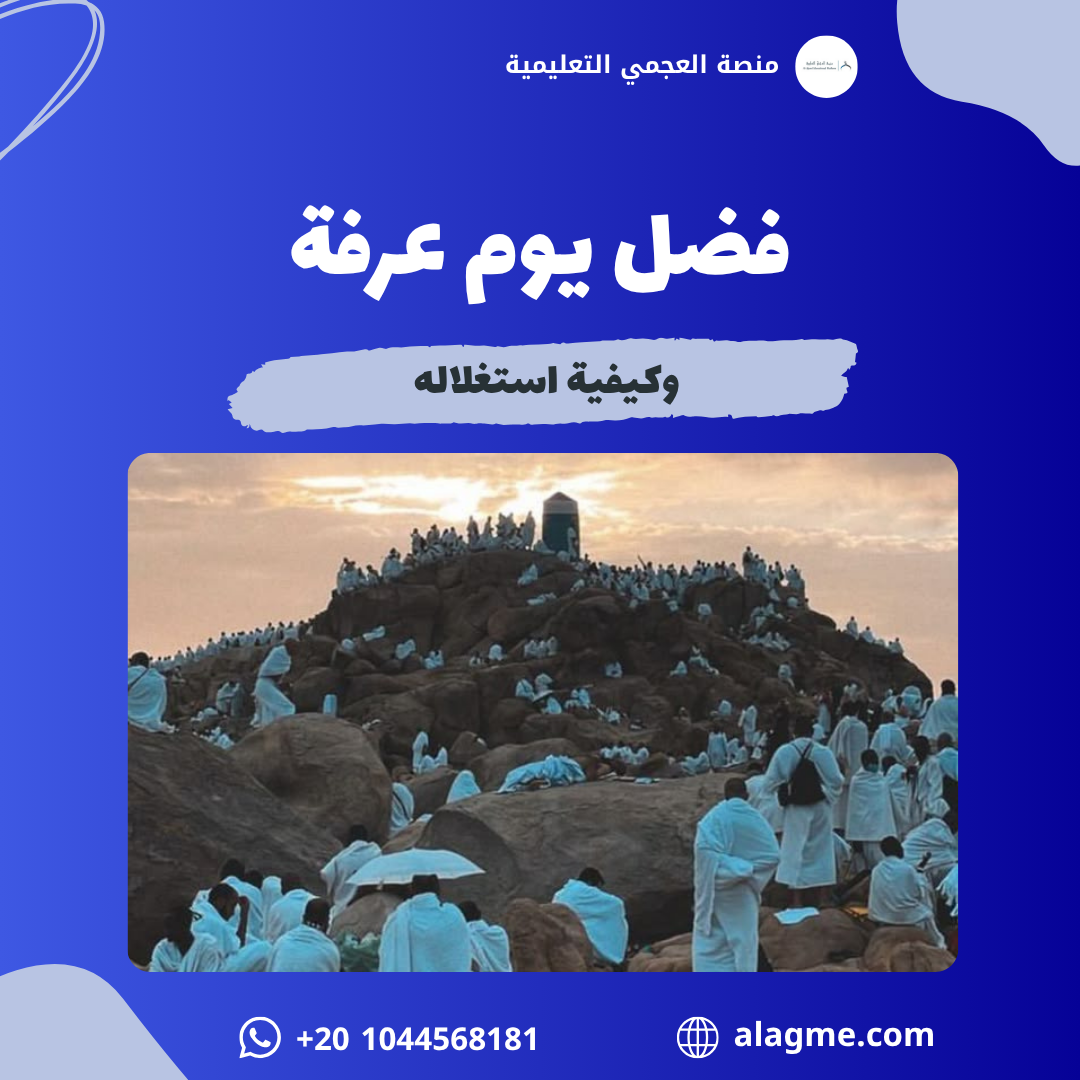
On the other hand, the pilgrims to the Sacred House of Allah experience a unique devotional journey on this day that is unmatched by any other. Standing at Arafah is the supreme pillar of Hajj, without which the pilgrimage is invalid, as the Noble Messenger explicitly declared: "Hajj is Arafah." On this pure plain, class, racial, linguistic, and national differences dissolve. Everyone wears a unified white garment resembling shrouds, standing on a single plain, raising their hands in supplication in various languages but with one heart, seeking Allah’s pardon and forgiveness.
This majestic scene is a miniature image of the grand Day of Resurrection, where creation gathers barefoot and naked before Allah, awakening the soul and instilling awareness of the Hereafter, while diminishing the value of transient worldly vanity. In this witnessed gathering, divine mercies descend in an unprecedented manner, and the Lord of Glory, Glorified and Exalted be He, draws near to His servants in a manner that befits His Majesty, boasting of the people of the earth to the inhabitants of the heavens. It is stated in the noble Hadith that the Prophet, peace and blessings be upon him, said: "There is no day on which Allah frees more slaves from the Fire than the Day of Arafah. He draws near, then He boasts of them to the angels, saying: 'What do these people want?'" This divine boasting reflects the human and spiritual value of the repentant believer, demonstrating how humility and brokenness at the threshold of servitude elevate the servant to the highest echelons of divine acceptance.
Psychological and Social Dimensions in the Farewell Sermon
The importance of the Day of Arafah is not confined to purely unseen and devotional aspects; it extends to encompass rights-based and social aspects that established the foundation of a just human society. On this day, during the Farewell Pilgrimage, the Noble Prophet delivered his eloquent sermon from atop the Mount of Mercy. This sermon is regarded by thinkers and historians as the first comprehensive global declaration of human rights. In this historical context, the Holy Messenger anchored the pillars of social peace and sanctified blood, property, and honor, saying: "Verily, your blood, your property, and your honor are as sacred to you as the sanctity of this day of yours, in this month of yours, in this land of yours."
The sermon of Arafah abolished pre-Islamic tribal fanaticism and racial discrimination, establishing the principle of absolute equality among human beings based on their single human origin. The sermon also heavily emphasized the rights of women and the obligation to treat them well, and prohibited usury because of the economic exploitation it causes, which destroys social cohesion. Hence, we must reread the Day of Arafah in this era not merely as an abstract ritual, but as a launching pad for renewing ethical awareness, consolidating bonds of human fraternity, and emphasizing the major higher objectives of Sharia, which came to preserve religion, life, intellect, honor, and wealth.
Managing Time and a Practical Program for the Muslim
A true academic understanding of the virtue of the Day of Arafah requires translating this virtue into a lived reality and a practical behavioral program that invests every single minute of this day. This investment begins with spiritual and psychological preparation starting from the preceding night, by forming a sincere intention to repent, desist from wrongdoing, and settle grievances and rights owed to people, for sins relating to human beings are not dropped except by fulfillment or pardon.
On the Day of Arafah, it is highly recommended for a Muslim to increase remembrance and supplication. It is narrated that the Prophet, peace and blessings be upon him, said: "The best supplication is the supplication on the Day of Arafah, and the best of what I and the Prophets before me have said is: 'There is no deity worthy of worship except Allah alone, without partner; to Him belongs dominion, and to Him belongs praise, and He is over all things competent.'" This specific remembrance represents the essence of monotheism and the negation of any partner with Allah, which firms monotheistic creed in the souls and directs the human compass toward the pleasure of the Creator alone. Muslims must also utilize the virtuous hours of this day, particularly the late afternoon time—from after Asr until sunset—which is the time when the Lord, Glorified and Exalted be He, manifests His grace upon His servants. One should completely disconnect during this time from worldly preoccupations, isolate oneself from digital distractions and social media, and turn entirely to supplication and seeking forgiveness for oneself, one's family, and the entire Islamic Ummah.
Conclusion
Based on the foregoing, it is evident that the Day of Arafah represents a unique legislative and educational phenomenon within the Islamic system, where the greatness of time meets the greatness of place and the depth of worship. Awareness of the virtues of this day should not stop at the boundaries of theoretical knowledge; rather, it must reflect positively on the moral and social behavior of the Muslim. It is a day for reshaping the self, washing hearts from grudges and hatred, and renewing the covenant with Allah to maintain uprightness and righteous work. There is no doubt that an Ummah that excels in utilizing these divine seasons, and realizes their rights-based and devotional dimensions, is an Ummah capable of civilizational revival and reclaiming its leadership role in spreading the values of truth, justice, and peace across the world. Let the Day of Arafah be a new starting point for every Muslim toward wider horizons of purity, piety, and continuous giving.


💬 اترك تعليقك