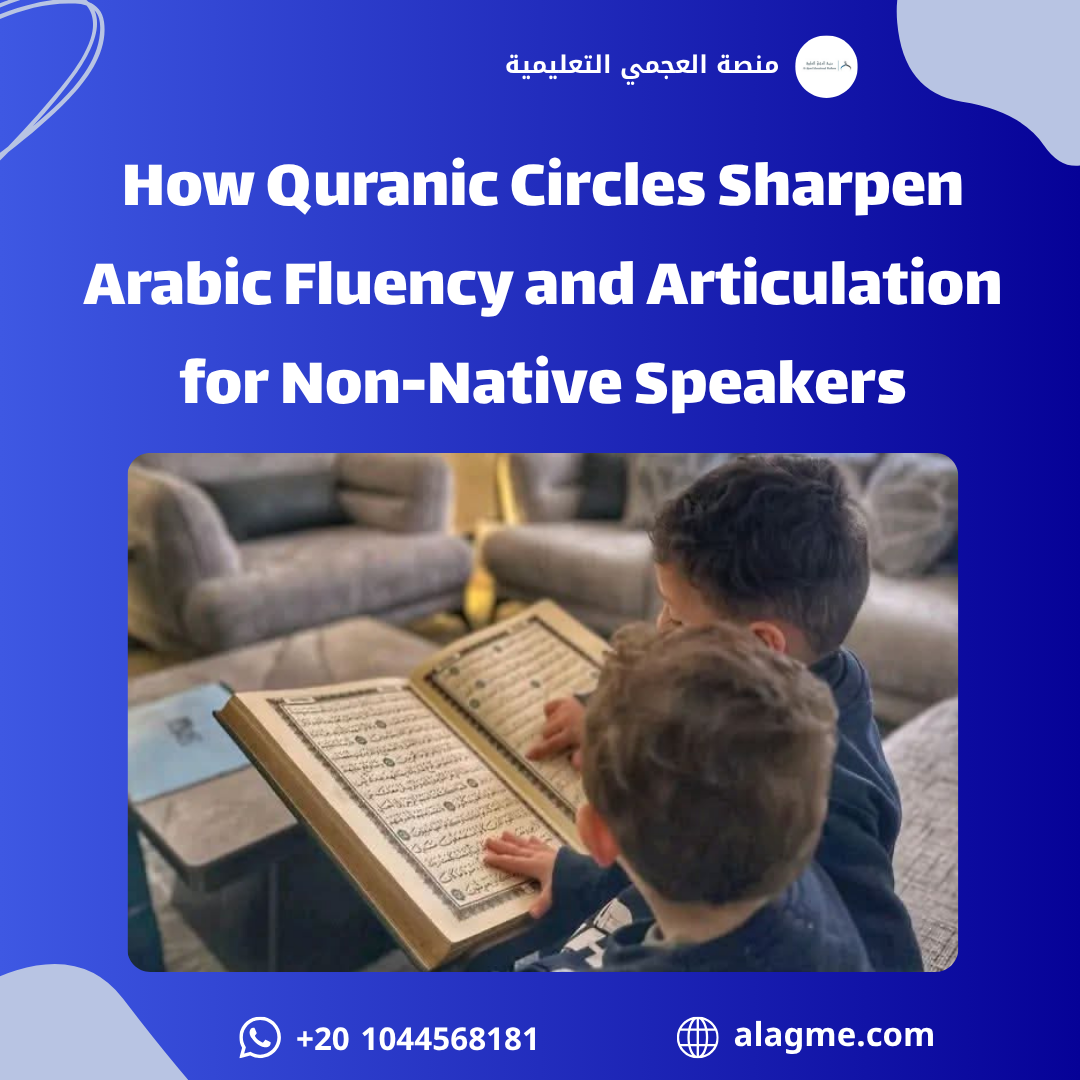
1. The Quran as the Ultimate Linguistic Standard
Arabic is unique because its formal version (Al-Fusha) has remained unchanged for over 1,400 years, primarily because of the Quran. While dialects change from country to country, the Quran remains the universal "Gold Standard."
For a student, learning Arabic through the Quran means learning the purest form of the language. You aren't just learning vocabulary; you are absorbing the most eloquent structures and rhythmic patterns that have defined Arabic literature for centuries. This exposure creates a "linguistic instinct" that helps students recognize correct grammar and syntax naturally.
2. Refining Articulation through Tajweed
The biggest challenge for non-native speakers is the "Makharij" (the exit points of letters). Arabic contains sounds that do not exist in English, French, or Urdu—such as the deep ‘Ayn (ع), the emphatic Saad (ص), or the breathy Haa (ح).
How Quranic circles solve this:
The Science of Tajweed: Tajweed is literally the science of "beautifying" and "perfecting" speech. It teaches you exactly where to place your tongue and how much breath to release for every single letter.
Mushafahah (Oral Reception): Unlike self-study apps, a live teacher at Alagme listens to your specific struggle. If you are pronouncing a Khaf (ك) like a Qaf (ق), the teacher provides instant correction. This "speech therapy" element of Quranic circles is the fastest way to eliminate a non-native accent.
Muscle Memory: Repeating verses under the guidance of a Qari trains the muscles in your throat and mouth to adapt to Arabic phonetics, leading to much clearer speech in daily Arabic conversation.
3. Building a Rich Vocabulary without Rote Memorization
Traditional language learning often involves memorizing long lists of words. In a Quranic circle, you learn vocabulary through context and repetition.
The Quran uses a core set of root words that reappear in different forms. As an "Ajami" student memorizes or recites, they begin to see how a single root like K-T-B (Write) transforms into Kitab (Book), Maktab (Office), and Kataba (He wrote). This structural understanding allows students to expand their vocabulary exponentially, making the transition to reading Arabic literature or news much smoother.
4. Developing the "Arabic Ear"
A major hurdle for non-Arabs is "Auditory Processing"—being able to distinguish between fast-spoken Arabic words.
Quranic recitation is governed by rhythm and melody (Tarteel). This rhythmic nature makes the sounds more distinct. By listening to a teacher and repeating the verses, the student’s brain becomes "tuned" to the frequency of the Arabic language. You start to "hear" the differences in short and long vowels (Harakat), which is essential for both understanding and speaking correctly.
5. Grammatical Intuition via "The Sound of Logic"
Arabic grammar (Nahw) is notoriously logical but can be difficult to memorize. However, the Quran is perfectly voweled. When a student consistently recites with the correct Fatha, Damma, and Kasra, they are subconsciously learning the rules of grammar.
For example, a student who recites "Qala Allahu" (Allah said) repeatedly will instinctively know that the subject of a sentence ends with a Damma sound, even before they take their first formal grammar class. The Quran provides the "examples" first, making the "rules" much easier to understand later.
6. Overcoming the Psychological Barrier
Many non-native students feel shy about speaking Arabic because they fear making mistakes. The environment of a Quranic circle—especially the supportive, one-on-one sessions at Alagme—is designed to build confidence.
Reciting the Words of Allah provides a sense of purpose that outweighs the fear of stumbling. As a student gains the ability to recite a full Surah with perfect Tajweed, that confidence overflows into their ability to speak Arabic in other settings. They no longer feel like an "outsider" to the language.
Why Alagme is the Perfect Choice for Non-Native Students
At alagme.com, we specialize in bridging the gap between the non-native speaker and the Divine Book. Our platform is tailored to the needs of the "Ajami" student:
Native-Level Accuracy, Student-Level Patience: Our teachers are experts in identifying the specific phonetic challenges faced by speakers of different languages.
The "Noor al-Bayan" Method: We utilize proven methods like Noor al-Bayan and The Qaida Noorania, which are specifically designed to teach non-Arabs how to read and pronounce Arabic with 100% accuracy in a very short time.
Flexible Online Learning: We understand the busy lives of students and professionals. Our 1-on-1 sessions allow you to learn from the comfort of your home, focusing entirely on your personal progress.
Comprehensive Curriculum: Beyond just memorization, we offer paths in the Forty Hadith and basic Arabic, ensuring a well-rounded linguistic and spiritual education.
Conclusion
The Quran is not just a book to be finished; it is a companion that sharpens your mind and your tongue. For a non-native student, every hour spent in a Quranic circle is an investment in both their Akhirah (Hereafter) and their mastery of the world's most beautiful language.
Don't let the language barrier hold you back. Your journey toward perfect Arabic speech begins with the first verse of the Quran.
Ready to transform your recitation and your Arabic?
💬 اترك تعليقك