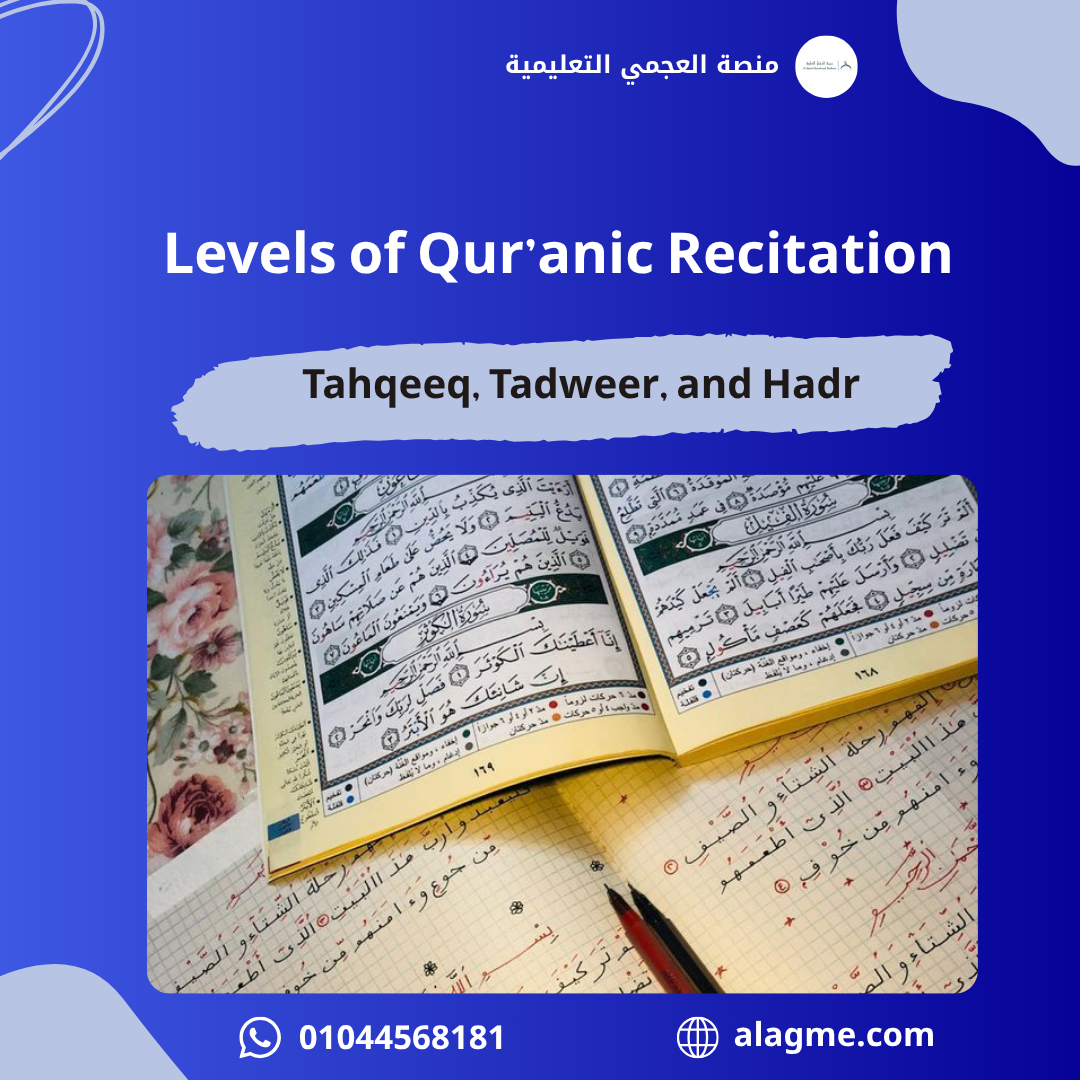
The levels of Qur’anic recitation are among the most important topics in the science of Tajweed. They explain the different ways a Muslim may recite the Book of Allah according to the situation and purpose, while fully preserving the rules of Tajweed, including the correct articulation points of letters, their characteristics, elongations (madd), and the rules of stopping and starting. Scholars of Qur’anic recitation have classified recitation into three primary levels: Tahqeeq (deliberate recitation), Tadweer (moderate recitation), and Hadr (rapid recitation). Each level has its own characteristics, guidelines, and appropriate occasions for use, ensuring that neither excessive speed nor excessive slowness compromises the correctness of the recitation.
Allah the Almighty says:
“And recite the Qur’an with measured recitation.” (Qur’an 73:4)
This verse serves as a foundational principle in this subject, emphasizing the importance of careful and clear recitation while maintaining reflection and humility. The Prophet Muhammad ﷺ recited the Qur’an at different paces depending on the circumstance. He would prolong his recitation during night prayers, recite slowly and carefully when teaching, and recite more briefly in prayers where lengthy recitation might be difficult for the congregation. This demonstrates the legitimacy of varying the levels of recitation according to need.
First: Tahqeeq (Deliberate Recitation)
Tahqeeq is the slowest and most meticulous level of recitation. It refers to very slow reading in which every letter is given its full rights and due characteristics, including precise articulation, complete application of elongations, proper nasalization (ghunnah), and careful observance of pauses.
Characteristics of Tahqeeq
Very slow pace of recitation.
Clear and complete elongation of madd letters.
Pronunciation of every letter with maximum clarity and precision.
Great attention to articulation points and letter characteristics.
Distinct pauses at the ends of verses or meaningful phrases to facilitate reflection.
Situations in Which It Is Used
Tahqeeq is primarily used in teaching and instruction, especially for beginners, because it helps students perfect pronunciation and identify mistakes. It is also commonly used in Qur’an memorization circles when correcting recitation.
Classical scholars paid particular attention to this level when teaching the Qur’an because its purpose is to establish accurate recitation before progressing to faster levels.
Second: Tadweer (Moderate Recitation)
Tadweer is the middle level between Tahqeeq and Hadr. It is a balanced style of recitation that is neither too slow nor too fast while maintaining complete adherence to the rules of Tajweed.
Characteristics of Tadweer
Moderate pace.
Full observance of Tajweed rules.
Balanced elongations without exaggeration.
Clear pronunciation combined with smooth flow.
Harmony between measured recitation and spiritual reflection.
Situations in Which It Is Used
Tadweer is the most commonly used style in prayer, especially in audible congregational prayers. It is also ideal for daily Qur’an recitation because it combines contemplation with reasonable pacing.
Many Qur’an reciters have favored this level because it closely resembles natural recitation that balances quality and ease.
Third: Hadr (Rapid Recitation)
Hadr is the fastest level of Qur’anic recitation. It refers to reading at a quicker pace while still maintaining correct pronunciation and proper application of Tajweed rules.
Characteristics of Hadr
Faster pace of recitation.
Relatively shorter elongations while still fulfilling their required lengths.
Reduced pauses whenever appropriate.
Preservation of correct pronunciation without negligence.
Suitable for covering larger portions of the Qur’an in a shorter time.
Situations in Which It Is Used
Hadr is commonly used during extensive recitation, such as completing the Qur’an, reviewing memorized portions, or reading large sections within limited time.
Although it is faster, scholars have strongly emphasized that speed must never lead to mistakes or negligence in pronunciation. Correct recitation always takes precedence over speed.
The Difference Between the Three Levels
The distinction between Tahqeeq, Tadweer, and Hadr can be summarized as follows:
Tahqeeq emphasizes maximum precision and very slow recitation.
Tadweer represents balance and moderation.
Hadr focuses on speed while maintaining correct recitation.
These levels are not contradictory; rather, they complement one another. A student often begins with Tahqeeq to establish correct pronunciation, progresses to Tadweer for balanced recitation, and eventually masters Hadr for situations requiring faster reading.
The Importance of Knowing the Levels of Recitation
Understanding the levels of recitation offers numerous benefits, including:
Achieving Excellence in Recitation
It helps the reciter understand that each situation may require a different style of reading.
Avoiding Mistakes
Tahqeeq minimizes errors during learning, Tadweer maintains balance, and Hadr teaches controlled speed without sacrificing accuracy.
Bringing Variety to Recitation
Alternating between different levels prevents monotony and enhances concentration and humility.
Adapting to Different Circumstances
A reciter may use Tahqeeq while teaching, Tadweer during prayer, and Hadr while reviewing memorized passages.
The Practice of the Prophet ﷺ Regarding Recitation Levels
The Prophet ﷺ recited the Qur’an at different paces depending on the occasion. He would lengthen his recitation during night prayer until his feet became swollen from standing, recite carefully when reflecting on the meanings of the Qur’an, and shorten his recitation in certain prayers out of consideration for the people.
In addition, Angel Jibreel (Gabriel) reviewed the Qur’an with the Prophet ﷺ every Ramadan, and during the final year of the Prophet’s life, this review occurred twice. This reflects the importance of precision, revision, and mastery in Qur’anic recitation.
Conclusion
The three levels of Qur’anic recitation—Tahqeeq, Tadweer, and Hadr—are not merely theoretical classifications. They form a practical framework that helps Muslims recite the Qur’an correctly in different circumstances. They also demonstrate the greatness of the Qur’an, which can be recited in various ways while remaining within the boundaries of proper Tajweed and correct pronunciation.
Anyone who wishes to achieve excellence in Qur’anic recitation should gradually master these levels: beginning with Tahqeeq to establish accuracy, moving to Tadweer for balance and fluency, and finally mastering Hadr while maintaining complete adherence to Tajweed rules. Throughout this journey, the reciter should preserve humility, reflection, and sincerity, so that the Qur’an becomes a source of light for the heart and a means of elevation in rank before Allah Almighty.

💬 اترك تعليقك