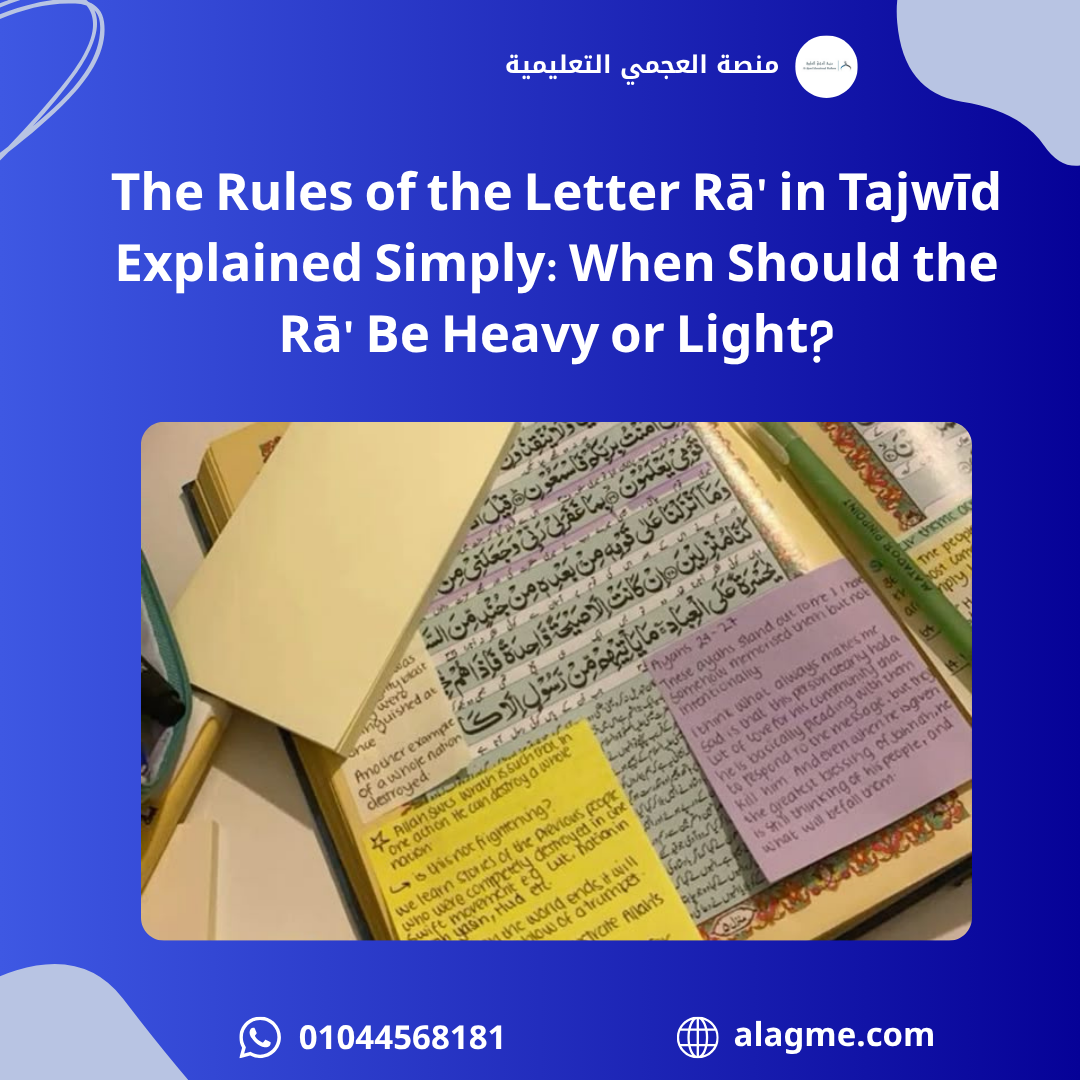
The rules governing the pronunciation of the letter Rā' (ر) are among the most important and frequently applied topics in Tajwīd. They are also among the subjects most commonly asked about by students of Tajwīd and beginners learning to recite the Qur'an. This is because the letter Rā' has a unique characteristic not shared by many other Arabic letters: in some situations it is pronounced heavy (Tafkhīm), while in others it is pronounced light (Tarqīq). There are also a few exceptional cases that require careful understanding to ensure the letter is pronounced correctly.
Since mistakes in making the Rā' heavy or light are common and directly affect the beauty and accuracy of Qur'anic recitation, learning these rules is an essential step for anyone seeking to improve their recitation and master the science of Tajwīd.
In this article, we will explore the meanings of Tafkhīm and Tarqīq, examine the rules governing the letter Rā' in detail, and provide Qur'anic examples to explain each case in a clear and simple manner.
What Are Tafkhīm and Tarqīq?
Before studying the rules of the letter Rā', it is important to understand the meanings of Tafkhīm and Tarqīq.
Tafkhīm refers to pronouncing a letter with a full, heavy sound, allowing its resonance to fill the mouth and giving it a strong and emphatic quality.
Tarqīq, on the other hand, means pronouncing a letter with a lighter, softer, and more delicate sound.
The letter Rā' is one of the letters that alternates between these two pronunciations depending on its vowel or the vowel that precedes it. Therefore, a reciter must learn the specific rules governing each situation.
Why Are the Rules of Rā' Important?
The importance of these rules lies in the frequent occurrence of the letter Rā' throughout the Qur'an. Moreover, mistakes in its pronunciation are easily noticeable during recitation.
Some people pronounce the Rā' heavily where it should be light, while others pronounce it lightly where it should be heavy. Such errors weaken the quality of recitation and violate the established rules of Tajwīd.
For this reason, scholars of Tajwīd developed clear principles to determine exactly when the Rā' should be pronounced with Tafkhīm and when it should be pronounced with Tarqīq.
Cases in Which the Rā' Is Pronounced Heavy (Tafkhīm)
In general, the Rā' is pronounced heavily in several specific situations.
1. When the Rā' Carries a Fatḥah
Every Rā' with a fatḥah is pronounced heavily.
Examples:
رَبِّ
رَحْمَة
رَسُول
فِرَاشًا
In each of these examples, the Rā' is pronounced with a full, emphatic sound.
2. When the Rā' Carries a Ḍammah
Every Rā' with a ḍammah is also pronounced heavily.
Examples:
رُزِقُوا
رُسُل
شُرُور
This is because the ḍammah is a strong vowel that naturally supports Tafkhīm.
3. When the Rā' Is Sākinah and Preceded by a Fatḥah
Examples:
الْقَرْيَة
مَرْيَم
فَرْض
Although the Rā' itself carries a sukūn, it is pronounced heavily because it is preceded by a fatḥah.
4. When the Rā' Is Sākinah and Preceded by a Ḍammah
Examples:
قُرْآن
بُرْهَان
قُرْبَة
Here, the preceding ḍammah causes the Rā' to be pronounced heavily.
5. When Stopping on a Sākinah Rā' That Is Preceded by a Fatḥah
Examples when pausing:
الْفَجْر
الْعَصْر
النَّحْر
When stopping at the end of these words, the Rā' is pronounced heavily because it is preceded by a fatḥah.
6. When Stopping on a Sākinah Rā' That Is Preceded by a Ḍammah
Examples when pausing:
الشُّكْر
الْأَمْر
الزُّبُر
In these cases, the Rā' is likewise pronounced heavily.
Cases in Which the Rā' Is Pronounced Light (Tarqīq)
Just as there are situations requiring Tafkhīm, there are also cases where Tarqīq is required.
1. When the Rā' Carries a Kasrah
This is one of the simplest rules.
Every Rā' with a kasrah is pronounced lightly.
Examples:
رِزْق
رِجَال
رِحْلَة
In each of these words, the Rā' should have a light and delicate pronunciation.
2. When the Rā' Is Sākinah and Preceded by an Original Kasrah
Examples:
فِرْعَوْن
مِرْيَة
شِرْذِمَة
Although the Rā' itself is silent, it is pronounced lightly because it is preceded by an original kasrah.
3. When Stopping on a Sākinah Rā' Preceded by a Kasrah
Examples when pausing:
خَبِير
بَصِير
قَدِير
When stopping on these words, the Rā' remains light because of the preceding kasrah.
Cases That Often Cause Confusion
Certain words require special attention because they are commonly misunderstood by students.
A Sākinah Rā' Preceded by a Kasrah and Followed by a Letter of Isti‘lā'
Examples:
مِرْصَاد
فِرْقَة
In such cases, scholars discuss the interaction between the preceding kasrah and the following letter of Isti‘lā' (an emphatic letter).
According to the narration of Ḥafṣ ‘an ‘Āṣim, the Rā' in the word:
مِرْصَاد
is pronounced heavy, despite the preceding kasrah, because of the influence of the following emphatic letter.
This is one of the exceptional cases that is best learned directly from a qualified teacher through listening and practice.
A Simple Rule for Remembering the Pronunciation of the Rā'
Beginners can remember the following guideline:
The Rā' is generally pronounced heavy when associated with a fatḥah or ḍammah, or when preceded by either of these vowels.
The Rā' is generally pronounced light when associated with a kasrah or preceded by an original kasrah.
This simple rule covers the vast majority of occurrences found in the Qur'an.
The relatively few exceptional cases can be studied later as one's understanding of Tajwīd advances.
The Difference Between the Rules of the Rā' and the Lām in the Name of Allah
A common mistake among students is confusing the rules of the letter Rā' with those governing the Lām in the Divine Name (Allah).
The pronunciation of the Rā' depends on its own vowel or the vowel preceding it.
The Lām in the Name of Allah, however, follows a separate rule:
It is pronounced heavy if preceded by a fatḥah or ḍammah.
It is pronounced light if preceded by a kasrah.
Therefore, the two topics should not be confused.
The Most Common Mistakes
Exaggerating Tafkhīm
Some beginners pronounce the Rā' with excessive force, producing an unnaturally heavy sound.
Correct Tafkhīm should always be moderate and free from exaggeration.
Pronouncing an Open Rā' Lightly
Some non-native Arabic speakers or speakers of certain regional dialects pronounce the Rā' lightly in words such as:
الرحمن
الرسول
الرزاق
In all these words, the Rā' must be pronounced heavily.
Pronouncing a Kasrah Rā' Heavily
Some reciters pronounce words such as:
رِزْق
رِجَال
with a heavy Rā'.
This is incorrect because the kasrah is one of the primary causes of Tarqīq.
Ignoring the Rule When Stopping
Some reciters change the pronunciation of the Rā' when stopping without considering the vowel that precedes it.
In most cases, when stopping on a word, the pronunciation of the Rā' depends on the vowel immediately before it.
How Can You Master the Rules of the Rā'?
The most effective way to master these rules is to combine theoretical study with consistent practical application.
Begin by memorizing the fundamental rule:
Fatḥah and ḍammah generally require Tafkhīm.
Kasrah generally requires Tarqīq.
Then, during your daily recitation, pause whenever you encounter a Rā' and ask yourself:
Is the Rā' carrying a fatḥah, ḍammah, or kasrah?
If it is sākinah, what vowel precedes it?
With regular practice, identifying the correct ruling will become automatic.
Listening to skilled Qur'an reciters such as Shaykh Mahmoud Khalil Al-Husary and Shaykh Muhammad Siddiq Al-Minshawi is also highly beneficial for developing the correct pronunciation of the Rā'.
The Importance of Mastering the Rules of the Rā'
Mastering the rules of the Rā' is not merely an academic exercise; it has a direct impact on the beauty and precision of Qur'anic recitation. The letter Rā' is one of the clearest sounds heard during recitation, and any mistake in making it heavy or light is immediately noticeable.
Learning these rules and applying them correctly gives the reciter greater confidence and brings them closer to the authentic manner of recitation that has been faithfully transmitted from the Prophet Muhammad ﷺ through successive generations.
Conclusion
The rules of the letter Rā' are among the fundamental chapters of Tajwīd and primarily revolve around knowing when the letter should be pronounced heavy (Tafkhīm) and when it should be pronounced light (Tarqīq). In general, the Rā' is pronounced heavily when it carries a fatḥah or ḍammah, or when it is preceded by either of these vowels. It is pronounced lightly when it carries a kasrah or is preceded by an original kasrah. By understanding these principles and practicing them consistently during Qur'anic recitation, applying the rules of the Rā' becomes natural and effortless.
Always remember that Tajwīd cannot be mastered through memorizing rules alone. It requires regular practice, listening to proficient Qur'an reciters, and learning directly from qualified teachers until one attains a beautiful and accurate recitation worthy of the words of Allah.
💬 اترك تعليقك