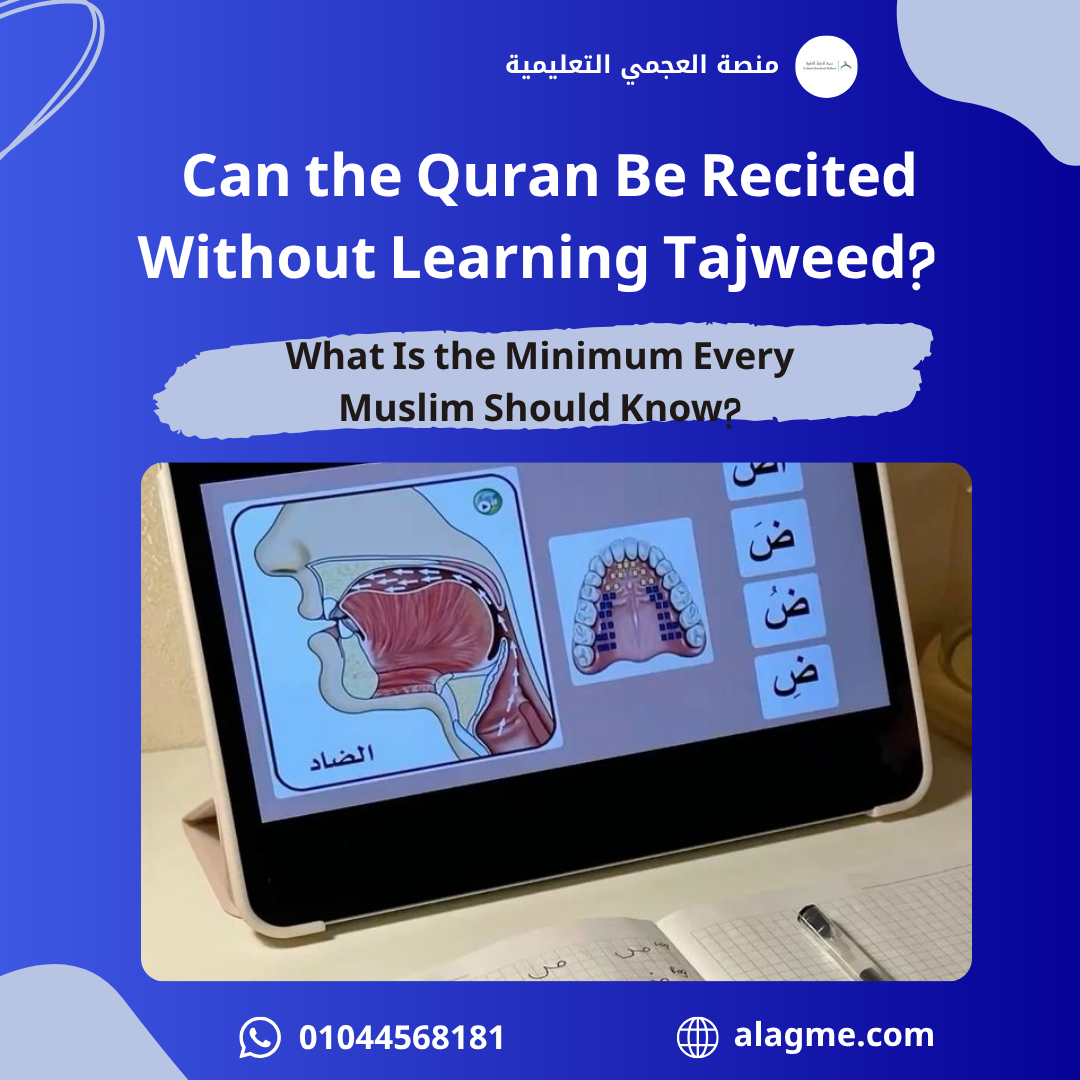
Muslims recite the Holy Quran seeking reward and blessings, as well as hoping to reflect upon and benefit from the words of Allah. With the widespread availability of Quran memorization circles, Tajweed courses, and increasing interest in proper Quranic recitation, many people ask: Can the Quran be recited without learning Tajweed? Is it necessary to master all the rules of Tajweed before beginning to read the Quran? Or is Quran recitation valid even if the reader is not a specialist in this field?
This question is commonly asked by beginners, especially those who have recently embraced Islam or those who have started their journey with the Quran later in life. It requires a clear and balanced answer that highlights the importance of Tajweed while also reflecting the ease and flexibility of Islamic teachings.
To begin with, it is important to understand that the Quran was revealed to be recited, contemplated, and acted upon. Allah Almighty did not make learning every detail of Quranic sciences a prerequisite for reading His Book. Every Muslim is able to recite the Quran according to their ability, and they are encouraged and rewarded for doing so, even if they are still at the beginning of their learning journey.
The Prophet Muhammad ﷺ said:
"The one who is proficient in the Quran will be with the noble and righteous scribes, and the one who recites the Quran and struggles with it, finding it difficult, will receive a double reward."
This noble hadith opens the door of hope for every Muslim who finds reading difficult or makes mistakes while learning. It confirms that the effort involved in learning the Quran does not deprive a person of reward; rather, it increases their reward when they are sincere and diligent in their efforts.
However, this does not mean that Tajweed is secondary or unimportant. On the contrary, Tajweed is the means by which the words of the Quran are preserved from distortion and error. Allah سبحانه وتعالى commands:
"And recite the Quran with measured recitation." (Quran 73:4)
This command includes clear, careful, and deliberate recitation in which letters are given their proper rights and words are pronounced correctly.
When we speak about Tajweed, we are not merely referring to prolonged elongations, beautifying the voice, or imitating famous reciters. First and foremost, Tajweed is about pronouncing the letters and words of the Quran correctly. In its essence, Tajweed is the mastery of Quranic recitation as it has been transmitted from the Messenger of Allah ﷺ through successive generations.
For this reason, scholars have distinguished between two categories of Tajweed rules: those that are essential for correct recitation and those that belong to the realm of perfection and beautification.
The first category concerns the correct pronunciation of letters and words and the avoidance of mistakes that alter meanings. If a reader substitutes one letter for another or changes a vowel in a way that changes the meaning of a word, this is considered an error that should be avoided. Therefore, every Muslim should learn the amount of Tajweed necessary to protect their recitation from such mistakes.
The second category includes detailed rules that enhance the beauty and precision of recitation, such as certain advanced aspects of elongation (Madd), nasalization (Ghunnah), and various styles of recitation. These rules are important and recommended, but they come after establishing a sound foundation in correct Quranic reading.
A common misconception is that a person must memorize all the chapters and rules of Tajweed before opening the Quran and beginning to read. This understanding is incorrect. The Quran should be read from the very first day, while Tajweed is learned gradually through recitation and practice. In fact, one of the best ways to learn Tajweed is to combine study with practical application during daily Quran recitation.
If we reflect upon the lives of the Companions رضي الله عنهم, we find that they did not learn Tajweed from textbooks or written manuals as many people do today. Rather, they learned directly from the Prophet ﷺ. They learned the verses, applied them practically, and then transmitted them exactly as they had heard them. Later, as Islam spread and non-Arab peoples entered the faith, scholars found it necessary to codify the rules of Tajweed in order to preserve the authentic method of Quranic recitation for future generations.
Today, learning Tajweed is easier than ever before. Online courses, virtual Quran classes, educational applications, and specialized instructional videos all help Muslims improve their recitation step by step without unnecessary hardship.
It is also important to note that many Muslims already apply a large portion of Tajweed rules naturally or through listening and imitation, even if they do not know the names of those rules. A person may correctly apply Madd Tabi‘i (Natural Elongation), Izhar (Clear Pronunciation), or Idgham (Assimilation) simply because they learned them by listening to teachers or skilled reciters, despite not knowing the technical terminology associated with them.
This demonstrates that the primary objective of Tajweed is not memorizing terminology but achieving correct recitation. Ultimately, what matters is the accuracy of one's recitation rather than the quantity of theoretical knowledge one possesses.
Regularly listening to skilled Quran reciters is also highly beneficial. Human beings are naturally influenced by what they hear repeatedly. When a person becomes accustomed to hearing correct recitation, their ear becomes more capable of recognizing mistakes and correcting them. For this reason, teachers often encourage students of the Quran to make listening a regular part of their daily routine.
It is equally important for Muslims to realize that learning Tajweed is a continuous journey rather than a temporary stage. Even accomplished reciters continue reviewing, practicing, and learning throughout their lives. The closer a person becomes to the Quran, the more eager they become to refine and improve their recitation.
Beginners should not become discouraged if they encounter difficulties or make frequent mistakes at the beginning. Mastering Quranic recitation requires time, patience, and practice. Success on this path is not achieved within a few days but through gradual and consistent effort.
Likewise, fear of making mistakes should never prevent a Muslim from reading the Quran. Some people delay recitation because they have not yet studied Tajweed, and this is a serious mistake. The Quran should be recited and learned at the same time. Read whatever you are able to read, strive to correct your mistakes, benefit from the guidance of teachers, and you will find your recitation improving over time.
In conclusion, reciting the Quran does not depend on studying every chapter and detail of Tajweed. Every Muslim can read the Book of Allah and receive reward according to their effort and ability. At the same time, every Muslim should strive to learn the essential level of Tajweed necessary to correct their recitation and avoid mistakes that alter the words or meanings of the Quran. Tajweed is not an obstacle to reading the Quran; rather, it is a means of perfecting, honoring, and preserving the words of Allah as they were revealed.
The more a Muslim progresses in learning Tajweed, the deeper their understanding of the Quran becomes, the more beautiful their recitation grows, and the greater their humility and devotion become during worship. Therefore, the best approach is to combine frequent recitation with continuous learning—reading the Quran every day while steadily improving one's recitation step by step—until we meet Allah having done our utmost to recite His Book in a manner that pleases Him.
💬 اترك تعليقك