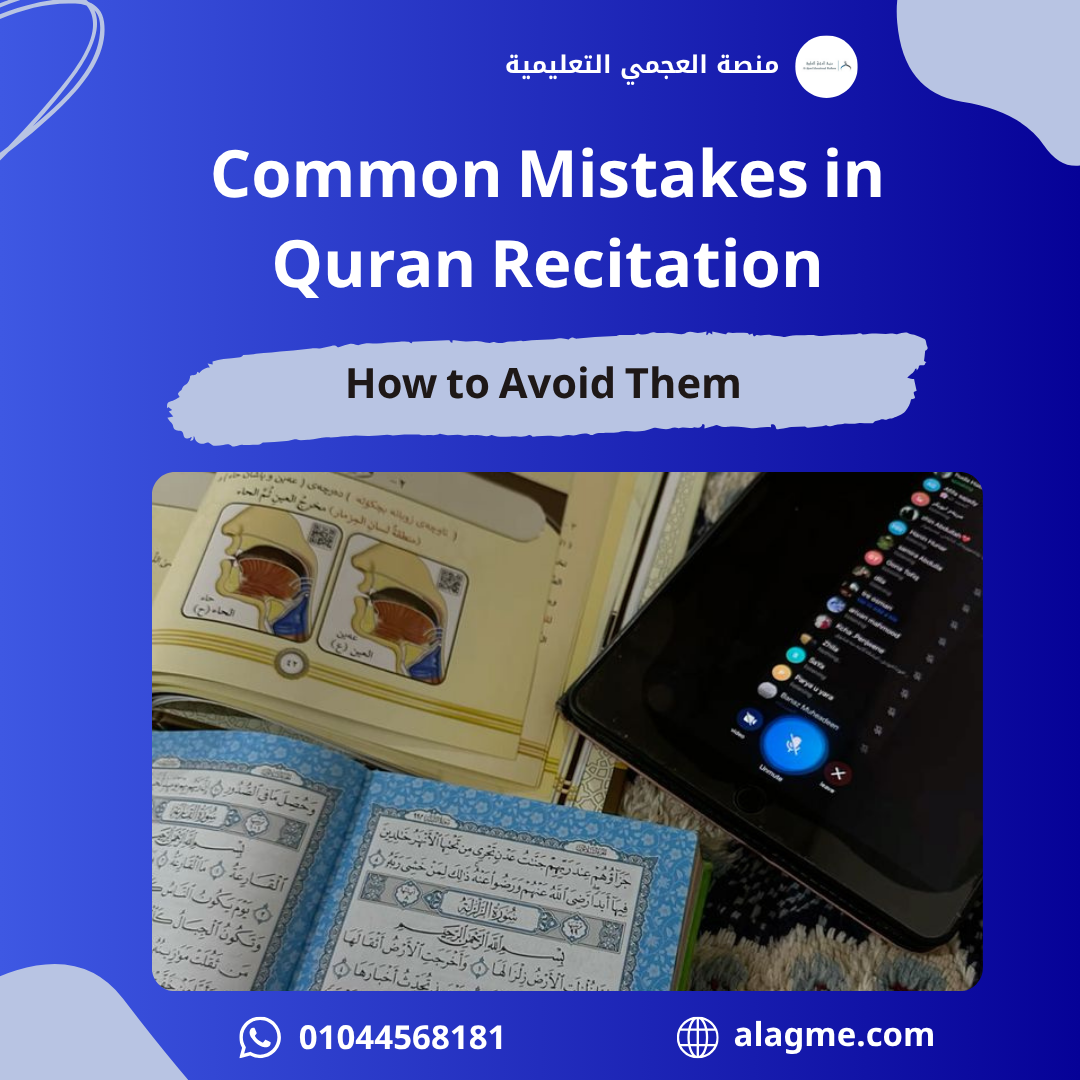
Reciting the Holy Quran is one of the greatest acts of worship through which a Muslim draws closer to Allah Almighty. It is an act of worship that combines reward, reflection, humility, and a deep connection with the words of Allah سبحانه وتعالى. Throughout history, Muslims have devoted themselves to learning the Quran, perfecting its recitation, and preserving its proper pronunciation as it was revealed to Prophet Muhammad ﷺ. Nevertheless, many people make mistakes while reciting the Quran. Some of these mistakes are minor and can be corrected easily, while others may affect the correctness of the recitation or even alter the meaning without the reader realizing it.
In reality, making mistakes while learning is completely natural. Every skilled reciter once began as a learner who needed correction, guidance, and practice. The issue is not the existence of mistakes themselves but rather continuing them without attempting to correct them or understand their causes. Therefore, recognizing common mistakes in Quran recitation is an important step for anyone seeking to improve their recitation and achieve a reading that is closer to the correct form.
One of the most widespread mistakes among reciters is confusing letters that have similar sounds. The Arabic language contains letters that may seem alike to those who have not properly learned their articulation points, such as Ṣād (ص) and Sīn (س), Ḍād (ض) and Ẓā’ (ظ), Ṭā’ (ط) and Tā’ (ت), or Qāf (ق) and Kāf (ك). When a reader confuses these letters, the Quranic word may be altered, or the clarity of the recitation may be weakened.
This usually occurs because of a lack of mastery of the articulation points of the letters or because of the influence of local dialects that differ from Classical Arabic. To avoid this mistake, one should dedicate time to learning the correct articulation points, listen regularly to skilled reciters, and practice pronunciation under the supervision of a qualified teacher whenever possible.
Another common mistake is failing to give vowel marks their proper pronunciation during recitation. Some readers do not clearly distinguish between the Fatḥah, Kasrah, and Ḍammah, or they read so quickly that the vowels become unclear. In reality, these vowel marks are an essential part of every word, and changing them can sometimes alter the meaning completely.
For this reason, a reciter should pay close attention to pronouncing vowel marks clearly and should read at a pace that allows every vowel to be pronounced exactly as it appears in the Mushaf. Frequent reading directly from the Quran also helps reinforce the correct forms of words and their pronunciation.
Another widespread mistake is neglecting the rules of elongation (Madd) or exaggerating them. Madd rules occur frequently throughout the Quran and add beauty and harmony to the recitation when applied correctly. However, some people shorten elongations that should be extended, while others prolong them excessively beyond the prescribed limits.
The solution is to learn the basic types of Madd, listen carefully to skilled reciters, and then attempt to imitate the correct application in a balanced manner without exaggeration or artificiality.
Some reciters also make the mistake of neglecting Ghunnah (nasalization) in its proper places. Ghunnah is a sound produced through the nasal passage and appears in certain rules such as Idgham and Ikhfa’. Some beginners omit it entirely, while others exaggerate it in a way that affects the natural flow of the recitation.
Since Ghunnah is primarily learned through listening rather than reading about it, the best way to master it is through repeated listening to proficient reciters and consistent practical training.
One of the most common mistakes is excessive speed during recitation. Many people focus on completing a large portion of the Quran in a short period of time, leading them to recite so quickly that they omit certain letters, vowel marks, or Tajweed rules.
Allah Almighty commanded:
"And recite the Quran with measured recitation." (Quran 73:4)
Measured recitation refers to clear and deliberate reading in which every letter receives its proper due. Therefore, a calm and careful recitation is usually more accurate and has a greater impact on the heart than a rushed recitation that lacks reflection and concentration.
Another important mistake is stopping at inappropriate places during recitation. The Quran is built upon interconnected meanings, and pausing at the wrong place may distort or even spoil the intended meaning. This is why scholars developed stopping signs in the Mushaf to guide readers to suitable places for pausing.
For example, a reader may stop in the middle of a sentence whose meaning has not yet been completed, or begin reading from a phrase that depends on what precedes it, resulting in confusion and misunderstanding. Therefore, learning the fundamentals of Waqf and Ibtida’ (stopping and starting) and paying attention to the signs found in the Mushaf is highly beneficial.
Another common mistake is relying solely on memory while reciting without regularly reviewing from the Mushaf. Many memorizers unknowingly repeat certain verses incorrectly, and over time these mistakes become firmly rooted in memory, making them more difficult to correct.
For this reason, it is always advisable to review memorized portions directly from the Mushaf on a regular basis to ensure the accuracy of the words, vowel marks, and overall recitation.
Some readers also make the mistake of ignoring small errors because they consider them insignificant. In reality, a minor mistake repeated many times can become a habit that is difficult to eliminate. Correcting mistakes early saves a great deal of effort in the future.
Another widespread mistake is attempting to imitate the voices of famous reciters before mastering the fundamentals of Tajweed. Some beginners focus on beautifying their voices or imitating melodies and tones before mastering articulation points and basic recitation rules. As a result, their voices may sound pleasant while obvious Tajweed mistakes remain present.
For this reason, the primary focus should always be on the correctness of recitation, while beautification of the voice should come afterward.
Some reciters are also influenced by their local dialects while reciting the Quran. They may pronounce certain letters according to their everyday speech rather than according to Classical Arabic pronunciation. This issue can affect letters such as Qāf, Jīm, and others.
To address this problem, one should consciously distinguish between everyday speech and Quranic recitation, while continuously listening to correct recitations and practicing the proper pronunciation of Arabic letters.
A lack of regular listening to the Quran is another reason why mistakes persist among some readers. Consistently listening to skilled reciters trains the ear to distinguish between correct and incorrect recitation and naturally improves one's own performance over time.
Among beginners, another common challenge is becoming discouraged by frequent mistakes. Some people assume that achieving correct recitation is extremely difficult, causing them to lose motivation or stop learning altogether. In reality, mastering Quran recitation requires patience and practice, and every accomplished reciter passed through stages of error and correction before reaching their current level.
For this reason, mistakes should be viewed as a natural part of the learning process rather than as evidence of failure or inability to improve.
Practical ways to avoid mistakes in Quran recitation include dedicating time each day to recitation, listening regularly to proficient reciters, reading before a qualified teacher or Shaykh whenever possible, consistently reviewing memorized portions from the Mushaf, and recording one's own recitation in order to identify areas that need improvement.
Learning the fundamentals of Tajweed also plays a major role in reducing mistakes and improving recitation. It is not necessary for every Muslim to become a specialist in Tajweed; rather, each person should learn enough to correct their recitation and protect themselves from significant errors.
In conclusion, reciting the Holy Quran is both a tremendous responsibility and a great honor for every Muslim. The more a person strives to improve their recitation and correct their mistakes, the closer they become to the words of Allah and the more deeply they experience the sweetness of the Quran within their heart. Mistakes should never be a cause for discouragement or abandonment; instead, they should be viewed as opportunities for learning, growth, and continuous improvement.
Make it a habit to recite the Quran daily, listen to skilled reciters, learn Tajweed gradually, and never hesitate to seek correction from knowledgeable teachers. With time, you will find that your recitation becomes more accurate, beautiful, and humble, and that your relationship with the Book of Allah becomes stronger and deeper than ever before.
💬 اترك تعليقك