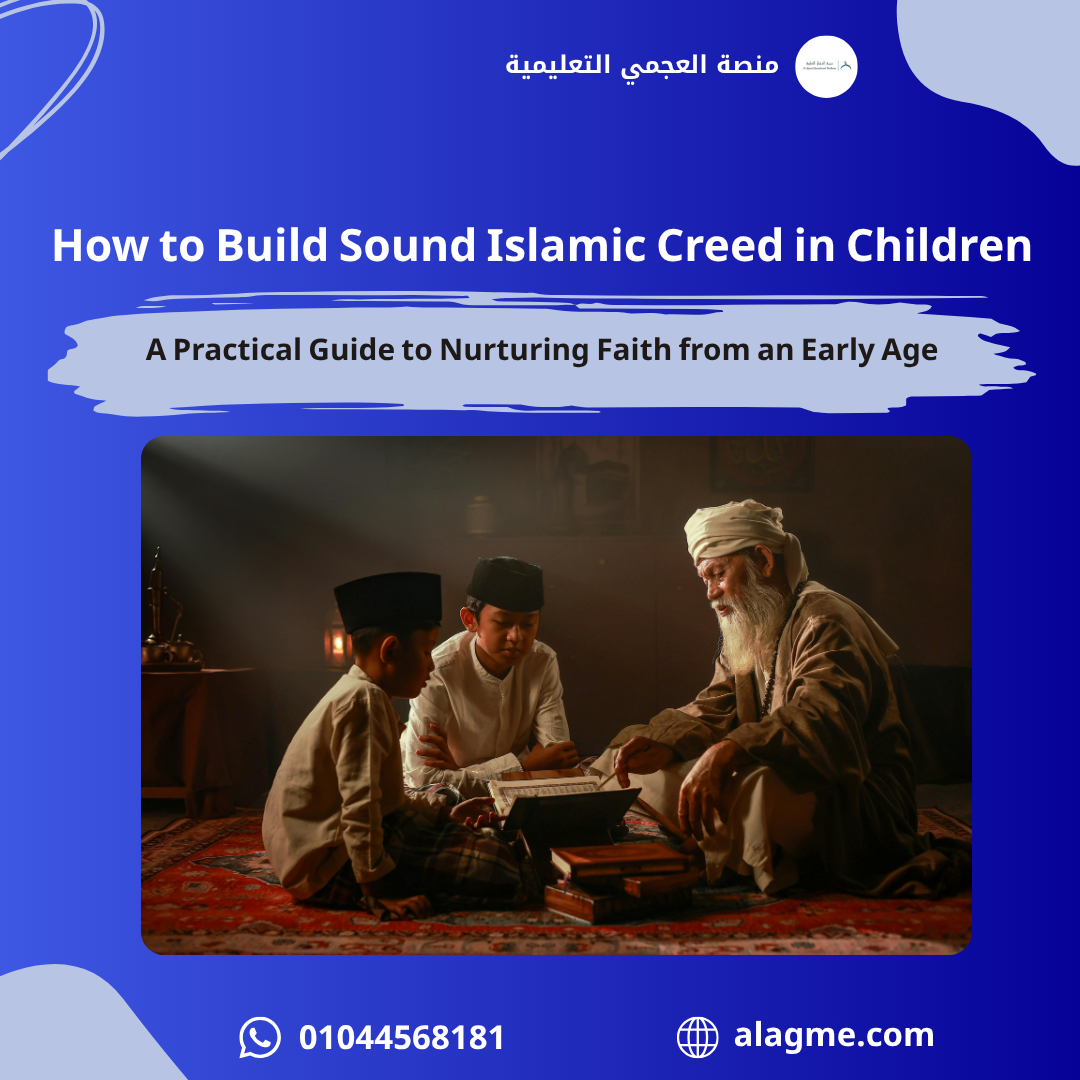
Childhood is one of the most important stages in a person's life, as it is during these formative years that character, values, beliefs, and ways of thinking begin to develop. It is the period when a child forms their first understanding of life, the world, and the people around them. For this reason, Islam places great emphasis on raising children. Its concern extends far beyond teaching them to read or perform acts of worship; rather, it considers establishing sound Islamic creed (Aqeedah) in their hearts to be one of the greatest responsibilities entrusted to parents and educators.
Aqeedah is not merely a subject to be memorized or a collection of complex theological concepts beyond a child's understanding. Instead, it is faith in Allah, trust in Him, reverence for Him, love for Him, knowledge of His Beautiful Names and Attributes, and belief in His messengers, revealed books, the Last Day, and divine decree. When children are nurtured upon these principles from an early age, they become deeply rooted in their personalities. Their hearts grow attached to Allah, they remain steadfast upon the truth, and they become better equipped to face doubts and ideological challenges as they grow older.
In today's world, this responsibility is more crucial than ever. Children are exposed to an unprecedented amount of media, internet content, and countless external influences. This makes instilling authentic Islamic creed not merely an educational choice but a religious and parental necessity.
The first step in building a child's Aqeedah is for parents to realize that faith-based upbringing begins during the earliest years of life—even before a child learns to read or write. Every child is born upon the natural disposition (Fitrah) with which Allah created mankind. The Prophet Muhammad ﷺ said:
"Every child is born upon the natural disposition (Fitrah), then it is his parents who make him a Jew, a Christian, or a Magian."
The pure human nature is naturally inclined to recognize and believe in Allah, but the surrounding environment shapes and directs that disposition. Therefore, the family's role in preserving and nurturing this innate faith is essential.
Teaching Aqeedah begins by introducing children to their Creator in a manner appropriate to their age, free from philosophical complexity or difficult terminology. Parents can simply explain that Allah created them, created the heavens and the earth, created the sun and the moon, provides for them, loves them, hears their supplications, and sees everything they do. Children are naturally curious, and the more they receive clear and simple answers, the stronger their connection with Allah becomes.
When children admire the beauty of nature, observe the rain, gaze at the stars, or look at trees and animals, parents should connect these moments to the greatness of the Creator. They can ask questions such as, "Who created all this beauty?" or "Who controls the alternation of day and night?" In this way, children gradually learn that the entire universe points to Allah's greatness and Oneness, allowing faith to develop naturally within their hearts.
It is equally important to teach children to love Allah before emphasizing fear of His punishment. Many parents focus heavily on warnings about Hellfire and punishment without speaking enough about Allah's mercy, generosity, and forgiveness. As a result, some children grow up associating religion primarily with fear. However, the Prophetic method established a balanced approach built upon love, hope, and fear together.
Children need to hear that Allah is Most Merciful, loves those who are truthful, forgives those who repent, rewards those who do good, answers prayers, and protects His believing servants. When a child truly loves Allah, obedience becomes something they desire rather than something imposed upon them.
Parents should also teach Allah's Beautiful Names in practical ways instead of expecting children to memorize them without understanding their meanings. Every Name can be connected to everyday experiences. If a child asks a difficult question, parents may explain that Allah is Al-'Aleem (The All-Knowing), who knows everything. If a child becomes afraid of the dark, they can be reminded that Allah is Al-Hafeez (The Protector), who safeguards His servants. If the child makes a mistake and sincerely repents, parents can explain that Allah is Al-Ghafoor Ar-Raheem (The Most Forgiving, The Most Merciful), who accepts repentance. In this way, Allah's Names become living realities rather than abstract concepts.
The Noble Qur'an is one of the greatest means of establishing Aqeedah in children. A child who grows up listening to the Qur'an, memorizing it, and understanding age-appropriate meanings naturally absorbs faith from an early age. Teaching the Qur'an should not be limited to memorization alone. Children should also be introduced, in a simple and understandable manner, to the Qur'an's teachings about Tawheed, Allah's greatness, the stories of the prophets, and the characteristics of righteous believers.
Likewise, the stories of the prophets are among the most effective educational tools for strengthening faith. Children are naturally captivated by stories far more than direct lectures. When they hear about Prophet Nuh's (Noah's) perseverance in calling people to Allah, Prophet Ibrahim's (Abraham's) courage in destroying idols and calling people to worship Allah alone, Prophet Musa's (Moses') trust in Allah while confronting Pharaoh, or the steadfastness of Prophet Muhammad ﷺ in conveying the truth, they learn the meanings of faith in a way that is both engaging and profound.
These stories should not be presented merely as historical events. Instead, parents should highlight the lessons they contain, explaining how the prophets relied upon Allah, remained steadfast upon the truth, and placed obedience to Him above everything else.
A righteous role model is no less important than direct instruction. Children learn more from what they observe than from what they hear. When they see their parents consistently performing prayer, reciting the Qur'an, remembering Allah throughout daily life, beginning their tasks by saying "Bismillah", and praising Allah for His blessings, they naturally understand that faith is an essential part of everyday life.
On the other hand, if children witness contradictions between what their parents say and how they behave, the effectiveness of religious instruction is greatly diminished. Therefore, building Aqeedah begins within the home before it begins in schools or books.
Another important method is connecting children with Allah during everyday situations. If they become ill, teach them to ask Allah for healing. If they succeed, encourage them to thank Allah for His blessings. If they become frightened, teach them to recite the prescribed supplications and place their trust in Allah. Whenever they receive a blessing, remind them to express gratitude to Allah. Through these experiences, children come to realize that Allah is always near, hears them, responds to their prayers, and cares for them in every circumstance.
Parents should also encourage open dialogue with their children. Young children naturally ask many questions about Allah, the universe, life, and death. It is a mistake to scold them or accuse them of disrespect simply because they ask difficult questions. Instead, parents should welcome these questions calmly, answer them according to the child's level of understanding, and seek reliable scholarly sources whenever further clarification is needed.
Establishing open communication from an early age encourages children to turn to their parents whenever future doubts arise rather than seeking answers from unreliable or misleading sources.
Children should also gradually become accustomed to acts of worship, as worship strengthens faith, while faith makes worship beloved to the heart. Prayer teaches children their connection with Allah. The Qur'an strengthens their faith. Supplication deepens their trust in Him. Fasting teaches them self-discipline and consciousness of Allah.
The Prophet Muhammad ﷺ emphasized gradual education when he said:
"Command your children to pray when they are seven years old."
This demonstrates that successful upbringing requires patience, consistency, and gradual development rather than harshness or coercion.
In today's world, parents must also protect their children from content that may corrupt their beliefs, whether through the internet, video games, television programs, or social media. This does not necessarily mean preventing children from using technology altogether; rather, it means guiding them wisely, supervising what they watch, selecting age-appropriate content, and teaching them how to distinguish truth from falsehood.
Children should also learn from an early age that Islam is a religion of knowledge and evidence, and that genuine faith never contradicts sound reasoning. On the contrary, the Qur'an repeatedly encourages reflection and contemplation upon Allah's creation. This nurtures confidence in Islam and protects children from blind imitation.
Some parents unintentionally make mistakes by focusing excessively on fear of punishment while neglecting Allah's mercy, emphasizing legal rulings before building faith, or burdening children with complex theological discussions beyond their level of understanding. Successful Islamic education always takes the child's developmental stage into account, gradually moving from simple concepts to deeper meanings as the child matures.
Likewise, constantly comparing children with others regarding Qur'an memorization or religious practice may cause them to associate religion with pressure and anxiety. Instead, parents should encourage them, praise their progress, and help them associate obedience with love for Allah and closeness to Him.
Parents should never neglect making sincere supplication for their children, for true guidance belongs to Allah alone. The prophets frequently prayed for their offspring to remain steadfast upon faith and righteousness. One of the most beautiful supplications is that of Prophet Ibrahim (Abraham):
"My Lord, make me steadfast in prayer, and [also] from among my descendants." (Qur'an 14:40)
Supplication, combined with sincere and consistent upbringing, is among the greatest means of raising righteous children who remain firm upon sound belief.
Conclusion
Building sound Islamic creed in children is not a temporary task but a lifelong educational journey that begins during the earliest years and continues throughout every stage of development. It is built by introducing children to their Creator, nurturing their love for Allah, teaching them the Qur'an and Sunnah, connecting them to acts of worship, providing righteous role models, encouraging open dialogue, answering their questions with wisdom, and constantly praying for their guidance and steadfastness.
When children are raised upon these foundations, they grow into adults with believing hearts, enlightened minds, and balanced personalities. They become better prepared to confront doubts, remain firm upon their religion, and draw closer to the obedience of their Lord. This is the greatest inheritance parents can leave for their children, for wealth eventually disappears and worldly status comes to an end, while sound Islamic creed remains with a person throughout this life and becomes the means of attaining Allah's pleasure and everlasting Paradise in the Hereafter.


💬 اترك تعليقك